
Abstracts of Winning Projects
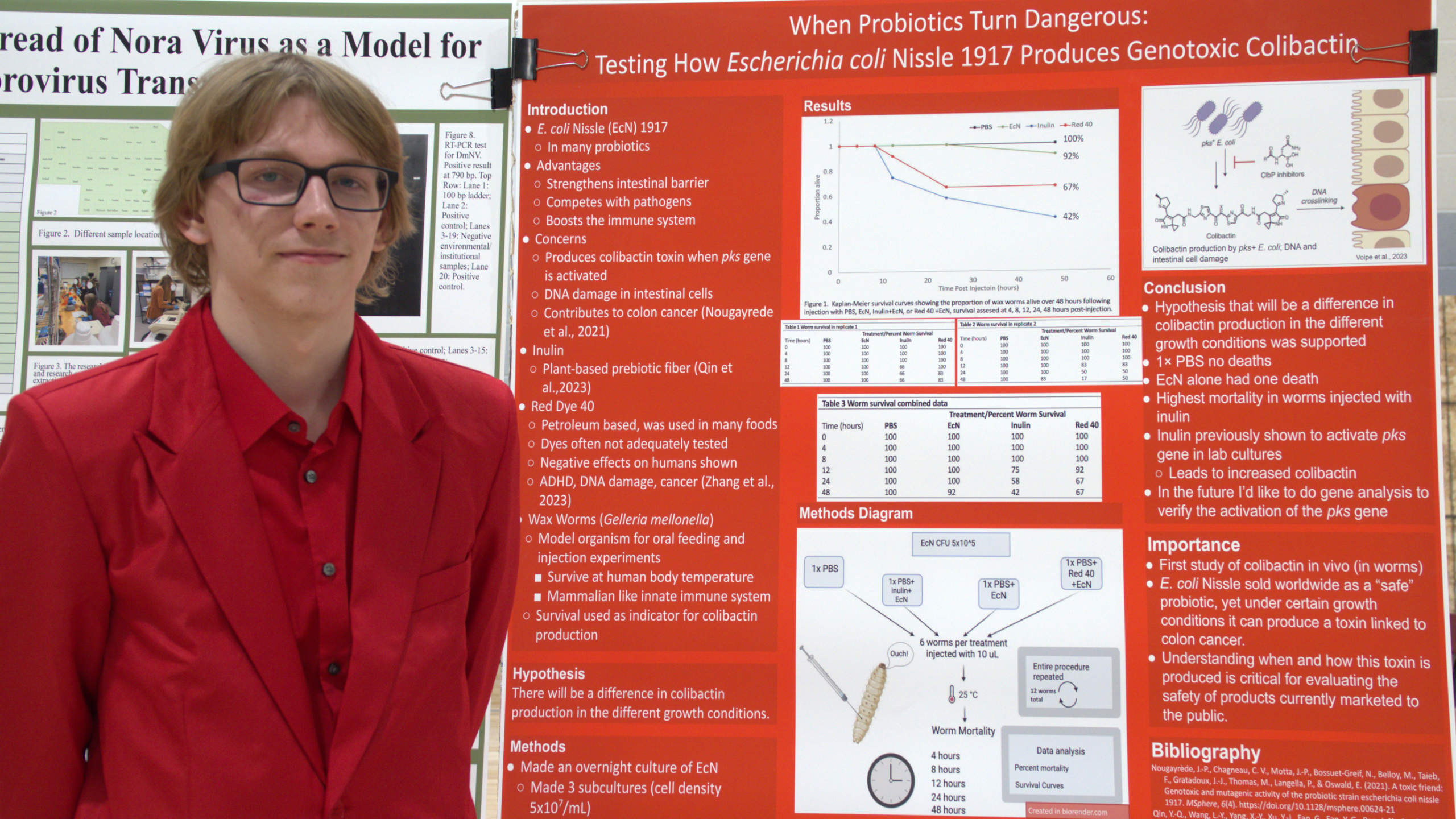
When Probiotics Turn Dangerous: Testing How Escherichia coli Nissle 1917 Produce Genotoxic Colibactin
Category: Microbiology (MCRO)
The purpose of this study was to investigate which conditions cause E. coli Nissle (EcN) to create colibactin. The hypothesis was that Red 40 would have an effect on colibactin expression. Cultures with EcN only, EcN and inulin, EcN and Red 40 were prepared, incubated for 4 hours, and standardized based on OD. These cultures, as well as a control of PBS, were injected into Galleria mellonella larvae, which were then incubated at 37 °C. They were monitored for mortality over five days to determine whether any of the growth conditions caused the EcN to produce colibactin by activating the pks gene. Survival curves were created. The worms injected with the inulin (positive control) had a higher mortality rate than the worms injected with Red 40, but both of these treatments had higher mortality rates than the worms injected with PBS alone (negative control) and EcN alone (baseline control). All of the worms injected with PBS survived, and all but 1 of the worms injected with just EcN survived.
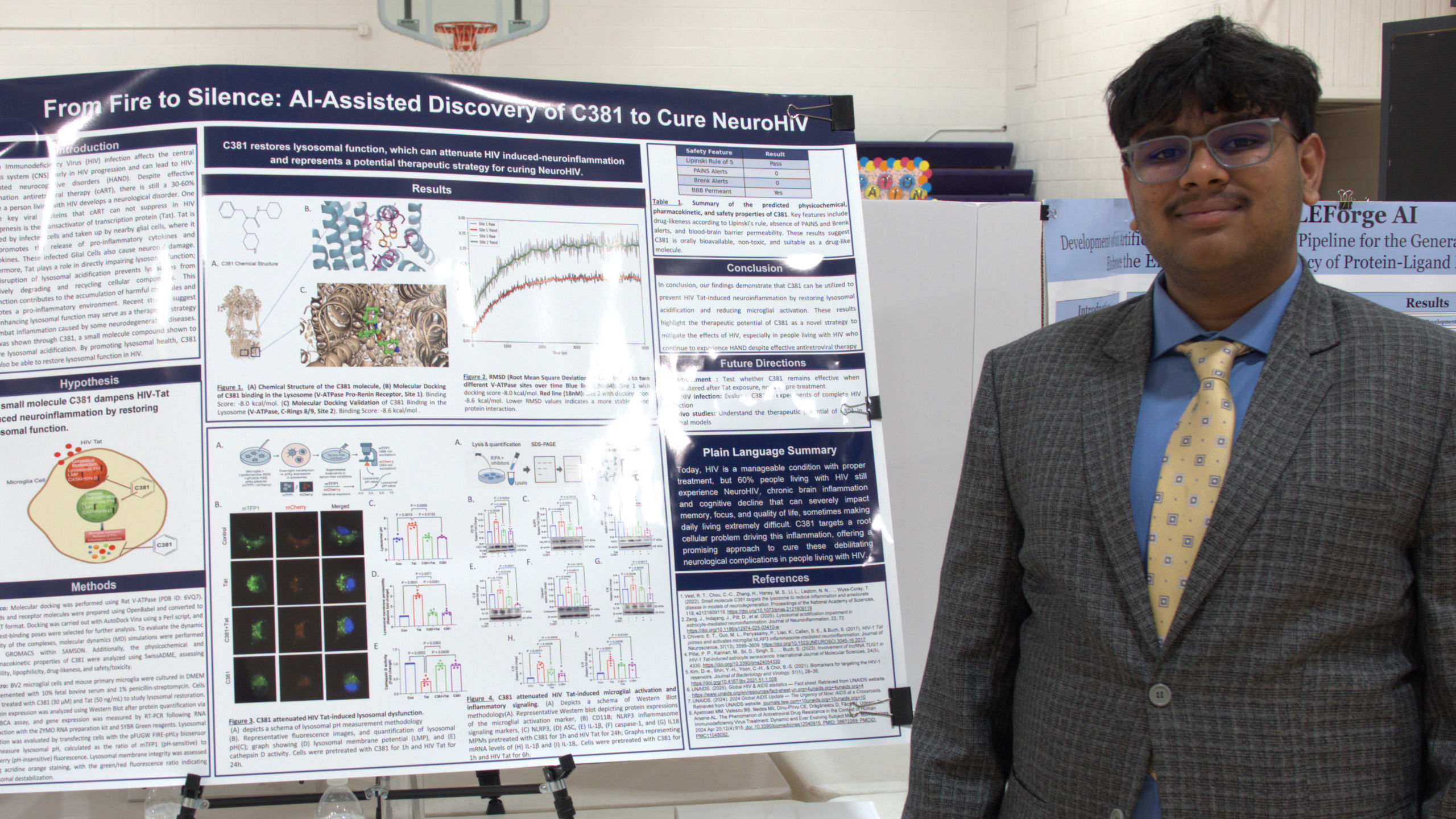
From Fire to Silence: AI-Assisted Discovery of C381 to Cure NeuroHIV
Category: Computational Biology and Bioinformatics (CBIO)
Introduction: Human Immunodeficiency Virus(HIV)-1 infection is associated with HIVassociated neurocognitive disorders (HAND), which can occur in 30–60% of people living with HIV, despite successful combination antiretroviral therapy (cART). The transactivator of transcription (Tat) protein contributes to HAND by impairing lysosomal acidification and promoting microglial neuroinflammation. C381, a small molecule previously discovered to restore lysosomal acidification, led us to hypothesize that it could also reduce HIV Tat-induced neuroinflammation. Methods: BV2 microglial cells were pre-treated with C381 (30 μM) and post treated with Tat (50 ng/mL). Western blotting and real-time PCR (RT-PCR) were used to measure inflammatory markers. Molecular docking was performed to identify C381 binding sites on the Lysosome (PDB ID: 6VQ7) using AutoDock Vina. Results: Molecular Docking identified the V-ATPase as the primary binding site of C381. The strongest sites on the V-ATPase were the pro-renin-receptor and the V-ATPase Crings 4/5 region which both play a role in acidifying the lysosome. In vitro, a C381 pretreatment was able to significantly reduce Tat induced neuroinflammation markers. Conclusion: In conclusion, C381 attenuates HIV-tat induced microglial neuroinflammation by restoring lysosomal acidification. Future studies will investigate post treating C381, utilizing in-vivo models, and including the full HIV infection, not just Tat.

Detection of brain structural alterations due to chronic nicotine abuse using in vivo diffusion tensor magnetic resonance imaging
Category: Biomedical Engineering (ENBM)
Smoking is the leading cause of preventable death in the United States. Although long term smoking causes severe damage to the lungs and respiratory system, it also results in brain atrophy and cognitive impairment. Similar findings were observed in chronic use of ecigarettes. Therefore, it is important to understand the involvement and alteration of various brain regions in nicotine addiction. In vivo diffusion tensor magnetic resonance imaging (DTMRI) can determine the structural integrity of the brain by measuring the diffusion properties of water molecules. In this research project, I hypothesized that in vivo DT-MRI can detect brain structural alterations caused by the chronic use of nicotine. To this end, the DT-MRI data were acquired on 9 mice at the baseline, 5- and 12-day time points. Immediately after the baseline data acquisition, the mice were injected intraperitoneally with nicotine solution once a day. ROI analysis was performed using the diffusion maps obtained from DT-MRI in different brain
regions. Initial results showed significant differences in diffusion measures between the baseline and 12-day time points indicating the brain structural damage caused by chronic nicotine use. In conclusion, in vivo DT-MRI is sensitive enough to detect brain alterations in a live brain due to
nicotine addiction.
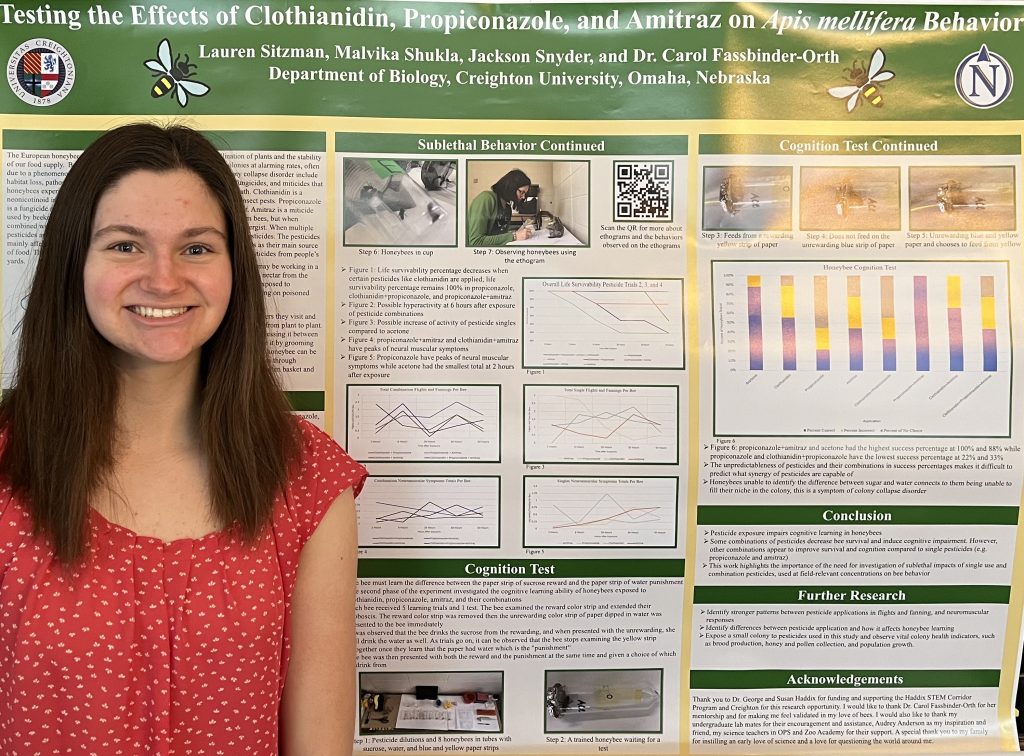
The Effects of Clothianidin, Propiconazole, and Amitraz on Apis mellifera Behavior
Category: Behavioral and Social Sciences (BEHA)
Beekeepers across North America lose their beehives at alarming rates to factors like pesticides. The direct exposure to neonicotinoids, fungicides, and miticides that Apis mellifera, honey bees, experienced while in commercial fields could cause honeybee death. In this two-part study of the synergistic effects of three common agricultural chemicals were studied; Clothianidin is a neonicotinoid insecticide that is coated on the plant seed to prevent pests. Propiconazole is a fungicide applied as a seed coating to protect plants from diseases. Amitraz is a miticide used by beekeepers. The first phase of the experiment tested the sublethal behavioral effects of neonicotinoids, fungicides, and miticides on Apis mellifera. With behavior observations, high rates of leg spasm, trembling, and tumbling trauma were connected to honeybees that have pesticide applications. Life survivability percentage decreased when certain pesticides like Clothainidin were applied but, life survivability percentage remains 100% in Propiconazole, Clothianidin+Propiconazole, and Propiconazole+Amitraz. The second phase tested the cognitive learning ability of honeybees exposed to Clothianidin, Propiconazole, and Amitraz in a pass/fail test. Honeybees not exposed to pesticides had a higher percent of learned success compared to honeybees exposed to pesticides. Of the eight combinations tested, Propiconazole+Amitraz and Acetone had the highest success percentage at 100% and 88% while Propiconazole and Clothianidin+Propiconazole had the lowest success percentage at 22% and 33%. This work highlights the importance of the need for investigation of sublethal impacts of single and combination pesticides used at field relevant concentrations on bee behavior.

Cross-species transmission of Drosophila melanogaster Nora virus in other species of insect and the prevalence of Nora virus in insect populations in Central Nebraska
Category: Microbiology (MCRO)
This study was performed to determine the cross-species transmission of the Drosophila melanogaster Nora virus in other species of insects and the prevalence of Nora virus in native insect populations in Central Nebraska. There are millions of known viruses, and new ones are discovered every year. A major source of new viruses is epizootic and enzootic animal viruses, seen when viruses typically occurring in animals adapt and mutate to infect humans. COVID-19 is an example of one of these host-switching viruses, as it originated in bats. The Nora virus is a picorna-like virus whose only known pathogenic effect is a geotaxis defect. The cross-species transmission of this virus can be used to help scientists better understand host-switching in other viruses. It was predicted that the virus would infect the other species and be present in native populations. To test this hypothesis, Nora virus-positive males were allowed to defecate on various combinations of fly food and dietary-specific foods. Once the flies were removed, insects of each species were added to the vials. Insects were also collected from the field to determine native virus presence. All insects were then tested via RNA analysis by RT-PCR using ORF1 gene-specific primers for detection of infection. In my previous study, Drosophila yakuba and Drosophila mercatorum showed positive infection, and while testing is ongoing, already the species Galleria mellonella, Tenebrio molitor, and Gryllodes sigillatus have shown positive infection. Learning more about cross-species transmission has increased importance in today’s world as the number of zoonotic viruses increases.